

How to Reduce No-Shows in Your Grooming Business: A Complete Guide for 2026
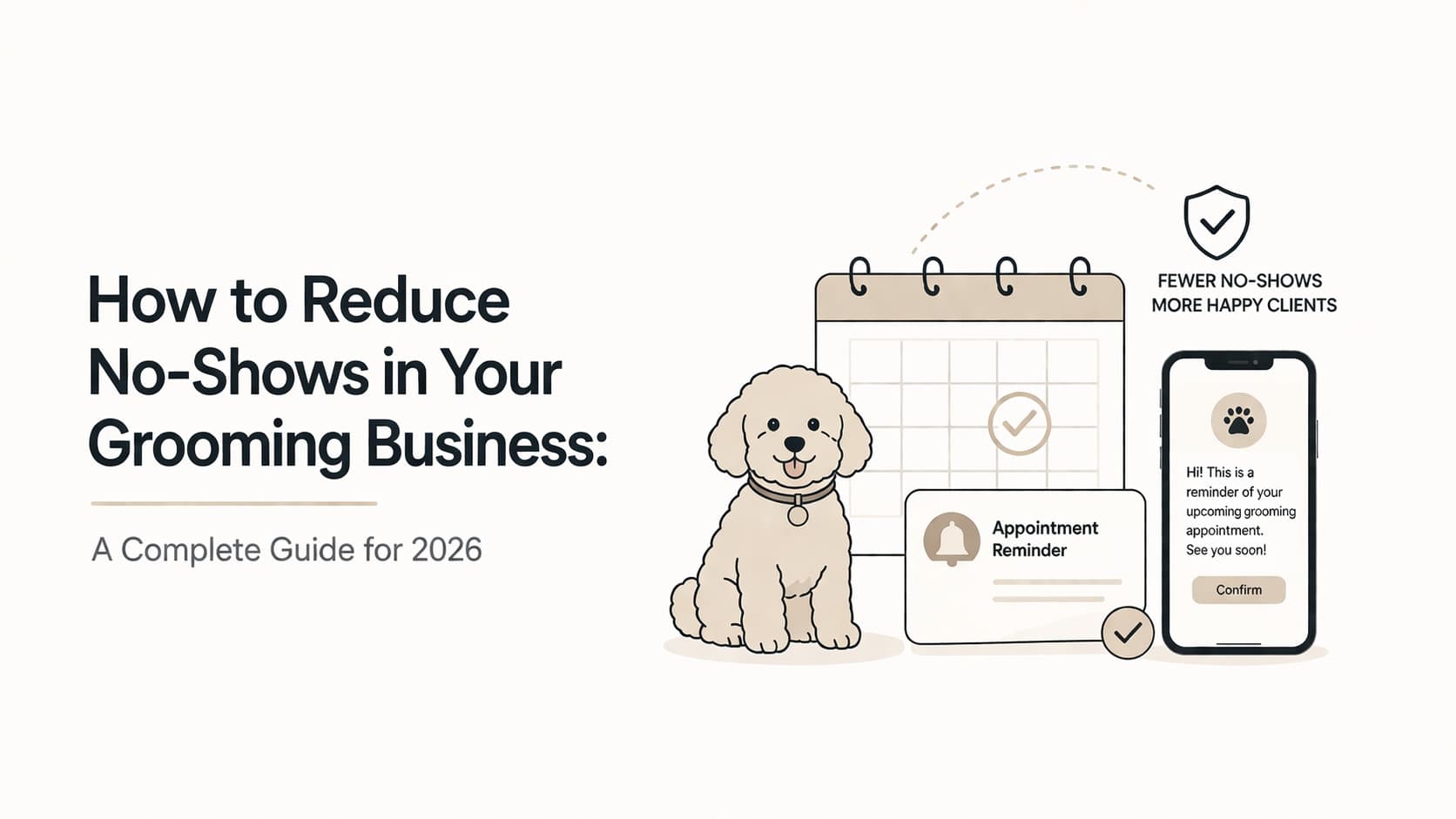
Discover proven strategies to cut grooming appointment no-shows in half. Learn SMS automation, confirmation systems, and client relationship tactics that actually work.
The No-Show Problem Nobody Talks About
Roughly 1 in 5 grooming appointments ends in a no-show or last-minute cancellation. For a shop running 30 appointments a week, that's 6 empty chairs, every single week.
That's not a bad week. That's your Tuesday, Wednesday, and Thursday morning wiped out. It's the client who texted you at 9:02 for a 9:00 appointment saying they "forgot." It's the grooming table you prepped, the staff you scheduled, the supplies you pulled "all for nothing".
No-shows are frustrating. More importantly, they're expensive. And for most grooming businesses, they're preventable.
In this guide, I'll walk you through every proven strategy for reducing no-show rates in 2026 from automated reminder systems to the quiet power of genuine client relationships. Whether you run a solo pet grooming studio or a multi-specialist salon, these tactics apply to your business, and most of them can be implemented this week.
Let's talk about money first, because that's what makes this urgent.
The Real Cost of No-Shows
Most shop owners think about no-shows as a scheduling annoyance. The real damage is financial, and it compounds quietly.
Lost direct revenue. If your average grooming appointment generates $65 in revenue and you're losing 5 appointments per week to no-shows and cancellations, that's $325 gone every week. Over a year, that's over $16,000 in lost income — money that should have paid for new equipment, a team bonus, or your own salary.
Wasted labor costs. Your specialist showed up, set up, and waited. You still paid them for that time. No-shows don't just cost you the revenue — they cost you the labor too. On a commission structure, that time is opportunity cost. On a salaried structure, it's a direct loss.
Supply waste. Towels were laundered. Products were prepped. Capes were set up. Small costs, but they add up when it happens 5–6 times a week.
Psychological drain on your team. This one is underrated. Specialists who repeatedly experience no-shows start to feel undervalued. It creates frustration that erodes morale — and morale is a retention factor you can't afford to ignore.
Opportunity cost. Every no-show slot is a spot you could have given to a paying client on the waitlist. If you're fully booked, that empty chair represents a real client you turned away.
The grooming industry's no-show rate hovers around 15–20% for businesses without reminder systems. For businesses with a proper automation stack, that number can fall to 3–5%. That difference is transformational
Why Clients Ghost Their Appointments
Before you can fix the problem, you need to understand it. Clients don't usually no-show because they don't care. They no-show for much more ordinary reasons.
They simply forgot. Life moves fast. A grooming appointment booked three weeks ago is easy to lose in the noise of a busy week. No malice — just human memory.
The booking process was confusing. If a client isn't 100% sure their appointment is confirmed, they assume it's not. An unclear booking process leads to "I wasn't sure if it went through" cancellations that happen — or don't.
They didn't receive a reminder. This is the most fixable cause. A 2024 study by Accenture found that 85% of patients who missed medical appointments said they would have shown up with a well-timed reminder. The same principle applies to your grooming clients.
Something came up and cancellation felt awkward. If a client doesn't know your cancellation policy, they might avoid the conversation entirely — and just not show up.
They booked with low commitment. Same-day bookings made impulsively have higher no-show rates than appointments made in advance with deliberate intent.
Understanding these root causes means your strategies can be targeted, not generic. Let's go through them one by one.
Strategy 1: Automated SMS Reminders That Actually Work
SMS is the highest-open-rate communication channel that exists. Text messages are opened by 98% of recipients, usually within 3 minutes of delivery. No email newsletter, push notification, or social post gets anywhere close to that.
That's why automated SMS reminders are the single most effective tool for reducing no-shows in a grooming business.
When to send them:
The ideal cadence for grooming businesses is a two-touch SMS strategy:
- 48 hours before the appointment: "Hi [Client Name]! Reminder: [Pet Name]'s grooming appointment is on [Day] at [Time] with [Specialist Name]. Reply YES to confirm or call us to reschedule. — [Shop Name]"
- Day-of, 2–3 hours before: "Hey [Client Name] — just a quick heads up: [Pet Name]'s appointment is today at [Time]. We're excited to see them! — [Shop Name]"
The 48-hour message gives clients time to reschedule if needed. The day-of message catches the client when the appointment is actually relevant — they're thinking about their day, not their week.
Personalization matters. "Hi Sarah, Bella's appointment is tomorrow" performs measurably better than "Reminder: appointment tomorrow." Use the client's name. Use the pet's name. Reference the service. People respond to messages that feel human, not automated.
Confirmation requests. Ask clients to reply YES to confirm. This does two things: it creates commitment (people who confirm are statistically less likely to bail), and it gives you a signal for who might not be coming. If someone doesn't reply by 24 hours out, that's a flag to follow up manually.
Groomera handles this automatically. When SMS reminders are enabled for a specialist, the platform fires day-prior and same-day texts through Bandwidth without you lifting a finger. You set it up once, and it runs.
Strategy 2: The Dual Reminder System (SMS + Email)
SMS alone is powerful. SMS combined with email is a system. They serve different functions and together, they cover both bases.
Email reminders are better for:
- Clients who prefer written records with full details
- Sending 3–5 days before an appointment (less intrusive than SMS at that distance)
- Including richer information: directions, parking, what to bring, prep instructions, your cancellation policy
- Re-engaging clients who opted out of SMS
SMS reminders are better for:
- High urgency, short lead time (48 hours and under)
- Immediate open rates
- Short, actionable messages with confirmation requests
The recommended dual-channel schedule:
Timing | Channel | Message Type |
5 days out | Full appointment details, policy reminder | |
48 hours out | SMS | "Confirm or reschedule" prompt |
Day of, 2–3 hrs | SMS | Friendly check-in |
This multi-touch approach feels like good service, not spam — because each message is timed right and adds value. The email is information. The SMS is a nudge. Together, they make it very hard to forget an appointment.
Groomera's booking system sends automated email reminders at both the 2-day and 1-day marks, running via a scheduled background job so they go out even on your days off.
Strategy 3: Pre-Booking Confirmations and Deposit Systems
Reducing no-shows at the time of booking — not just before the appointment — is your most powerful lever. When clients have skin in the game, they show up.
The 48-Hour Confirm-or-Cancel Rule.
Send a confirmation request when the appointment is booked, not just before it. A simple message: "Your appointment is pending confirmation. Please confirm within 48 hours or it may be released to another client." This filters out low-commitment bookings without being rude.
Deposit Systems.
A partial deposit at booking — even $10–$20 — dramatically reduces no-shows. The psychology is simple: people who have paid something, even a small amount, feel a sense of ownership over the slot. Cancellation suddenly has a real cost.
For high-value services (full grooms over $100, multiple pets, specialty coats), a 25–50% deposit is reasonable and increasingly industry-standard. Most clients who are genuinely planning to show up won't blink at it.
Communicate it as protection for both sides. "We hold your spot with a small deposit, which goes toward your total. We only ask because our specialists' time is pre-scheduled, and we want to make sure your pet's slot is guaranteed." This framing makes the deposit feel fair, not punitive.
Cancellation windows. Pair your deposit system with a clear cancellation window — typically 24 to 48 hours. Clients who cancel within the window lose the deposit. Clients who cancel early enough get it back. This structure incentivizes communication, which is exactly what you want.
Strategy 4: Build Client Relationships That Make Cancellation Hurt
This strategy is slower to implement than the others, but it's the most durable. Loyal clients who trust your shop, know your specialists, and feel personally connected to the experience are dramatically less likely to no-show.
When cancellation means letting down a person — not just a business — the psychological calculus changes.
How to build those relationships:
Know your clients' pets. Remember Bruno's sensitive ears. Know that Luna is anxious around other dogs. These details — tracked in your client notes — let your specialists greet every client as if they're a regular, even on a busy day. Clients who feel remembered become loyal clients.
Follow up after appointments. A quick thank-you message after a visit — especially after a new client's first appointment — goes a long way. Groomera automatically triggers Google review request emails after a booking is marked complete, which doubles as a touchpoint that keeps you top of mind.
Celebrate milestones. Long-time clients appreciate recognition. A birthday shoutout for a pet, a "welcome back" message for a client who was away — these tiny gestures build the emotional glue that makes cancellation feel like letting down a friend.
Make rescheduling easy, not awkward. Sometimes life genuinely gets in the way. When you have good relationships and an easy rescheduling process, clients will call ahead rather than disappearing. That empty slot becomes a reschedule opportunity, not a lost appointment.
Strategy 5: A Clear Cancellation Policy That Clients Actually Read
Unclear policies breed avoidant behavior. If a client doesn't know what happens when they cancel, they'll make assumptions — and usually err on the side of not calling.
Your cancellation policy needs to be:
Written plainly. "Please give us 24 hours' notice for cancellations. Late cancellations or no-shows may be subject to a [X]% fee or loss of deposit." No legalese. No jargon.
Visible at every touchpoint. Include it in your booking confirmation email. Include it in your reminder messages. Post it on your public storefront. It shouldn't be a surprise — it should be something every client has seen at least twice before their appointment.
Enforced consistently but humanely. A client who no-showed with no history of issues probably deserves grace the first time. A repeat offender should face the policy. Consistency matters because your team needs to trust that the rules apply.
A real example that works:
"We understand life happens! We just ask for 24 hours' notice so we can fill your spot with another pet in need. Cancellations within 24 hours may forfeit the deposit or incur a small fee. Thank you for respecting our specialists' time."
That's warm. It's clear. It doesn't feel punitive. And it actually communicates why the policy exists, which makes clients more likely to follow it.
How Specialists Can Personally Reduce Their Own No-Shows
If you're a specialist, you have more influence over your personal no-show rate than you might think. Clients who have a relationship with their specific groomer are significantly more likely to honor appointments.
Keep notes. After every appointment, jot down the details: what products you used, how the pet behaved, what the client mentioned. When you greet them next time with "How was Bruno's ear infection? Is it all cleared up?" — that's not magic. That's just professionalism. And it builds loyalty.
Build your own client base. As a specialist, your repeat clients are your career security. Clients who request you specifically will go out of their way to keep the appointment — and reschedule when they can't, rather than just vanishing.
Send personal check-ins for high-value appointments. If you have a complex groom, a new client, or a longtime regular booked, a quick personal message — "Looking forward to seeing Bella tomorrow!" — is a two-minute investment that makes cancellation feel personal.
Use your schedule visibility. Groomera's specialist portal shows your full calendar so you can plan ahead. If you notice an appointment with a historically inconsistent client, you can flag it for a manual follow-up.
How Technology Handles This So You Don't Have To
The hardest part of most no-show reduction strategies isn't knowing what to do — it's doing it consistently, for every client, every appointment, without burning out.
That's what automation is for.
A modern booking system should handle:
- Automated SMS reminders on a timed schedule you configure once
- Email reminders triggered automatically from the moment a booking is confirmed
- Confirmation requests embedded in the reminder flow
- Client history and notes stored centrally so any specialist can access them
- Status tracking so you always know which appointments are confirmed vs. pending
Groomera's booking management system handles all of this. The reminder cron job runs automatically, so your 6 AM Saturday appointments get a reminder even if you're still asleep. The AI Voice Assistant answers inbound calls 24/7, so clients who want to reschedule at 10 PM can do so without calling you at home.
The result? You spend less time chasing confirmations and more time actually grooming.
Try it yourself: Groomera's reminder system is included in every plan. Start your free 14-day trial and see how many confirmations come back in your first week.
Your 30-Day No-Show Reduction Action Plan
Here's a simple roadmap you can start today:
Week 1: Set up your reminder system
- Enable SMS reminders for all active specialists
- Confirm your booking confirmation emails are going out
- Review your current no-show rate (look at last month's data)
Week 2: Audit your cancellation policy
- Write or update your cancellation policy in plain language
- Add it to your booking confirmation email and your public storefront
- Train your team on how to apply it consistently
Week 3: Add deposits for high-value bookings
- Define which services will require a deposit (full grooms, new clients, specialty coats)
- Set up your deposit collection through Stripe via the booking flow
- Communicate the change to clients in a brief, friendly message
Week 4: Build your client relationship foundation
- Audit your client notes — are they detailed enough for personalization?
- Ask specialists to add notes after each appointment this week
- Set up a Google review email trigger for completed bookings
Track your results. Compare your no-show rate at the end of 30 days to your starting rate. Most grooming businesses see a 40–60% reduction in no-shows after implementing a full reminder system.
FAQ: Everything You're Wondering About No-Show Prevention
Q: How much do SMS reminders actually cost?
SMS costs vary by provider. At Groomera, SMS reminders are available as a per-specialist add-on at $5.99/specialist/month, far less than the revenue a single no-show represents. The math makes it a no-brainer.
Q: What if clients opt out of text messages?
That's why the dual SMS + email system matters. Clients who opt out of SMS still receive email reminders. For clients who opt out of all reminders, a simple phone call from a specialist 24 hours out covers the gap.
Q: Should I charge a no-show fee for first-time offenders?
This depends on your business culture. Many owners give one grace pass for established clients with a note in their file. First-time no-show clients often get a gentle reminder of the policy. Repeat offenders face the fee. The key is consistent communication, the policy should never be a surprise.
Q: My clients are mostly older — will SMS reminders work for them?
Yes, but your email reminders become more important. Older clients often prefer email. The dual-system approach covers both demographics without extra effort.
Q: Can I use the AI assistant to call clients instead of sending texts?
Groomera's AI Voice Assistant currently handles inbound calls. Outbound reminder calls are available through the specialist SMS + email system. Clients who want to reschedule can call back and the AI handles the conversation automatically.
Q: What if I run a walk-in-friendly shop — does this apply?
If you do any appointment-based bookings (which most shops do, even if they also take walk-ins), yeah these strategies apply to that segment. Even reducing no-shows on 50% of your volume has a meaningful revenue impact.
Q: Is it okay to remove chronic no-show clients from my books?
Absolutely. After two or more no-shows with no follow-up, you're within your rights to require a deposit for future bookings or to politely indicate that your calendar is no longer available to them. Your specialists' time has real value.
Start Protecting Your Revenue Today
No-shows aren't inevitable. They're a symptom of a system that doesn't have the right automations, policies, or relationships in place — and every one of those things is fixable.
The businesses that run tight no-show rates aren't lucky. They're systematic. They send reminders. They have policies. They build genuine connections with their clients. And increasingly, they use technology to do the consistent, unglamorous work that makes it all happen without burning out their front desk.
You don't have to overhaul your whole operation at once. Pick one strategy from this guide and implement it this week. Then add another. Within 30 days, you'll see the difference.
Ready to automate your reminder system? Groomera handles SMS and email reminders, booking confirmations, and client tracking, so you can focus on the craft, not the calendar. Start your free 14-day trial at groomera.com and see no-show reduction in your first week.